Upload Sketches to Arduino Micro With Ftdi
Getting Started with the Arduino Pro Mini
The first steps to setting upwardly the Arduino Pro Mini
The Arduino Pro Mini is intended for avant-garde users who require flexibility, low-cost, and small size. It comes with the minimum of components (no on-board USB or pin headers) to go on the cost downwards. It'southward a good choice for a board you want to leave embedded in a project. Please annotation that there are two versions of the lath: one that operates at 5V (like most Arduino boards), and one that operates at iii.3V. Be certain to provide the correct ability and employ components whose operating voltage matches that of the board.
The Arduino Pro Mini is programmed using the Arduino Software (IDE), our Integrated Development Surroundings mutual to all our boards and running both online and offline. For more information on how to become started with the Arduino Software visit the Getting Started page.
Use your Arduino Pro Mini on the Arduino Web IDE
All Arduino boards, including this one, work out-of-the-box on the Arduino Spider web Editor, you only need to install Arduino Create Agent to go started.
The Arduino Spider web Editor is hosted online, therefore it will always be upwards-to-date with the latest features and support for all boards. Follow this uncomplicated guide to start coding on the browser and upload your sketches onto your board.
Utilise your Arduino Pro Mini on the Arduino Desktop IDE
If y'all desire to programme your Arduino Pro Mini while offline you need to install the Arduino Desktop IDE
The board comes without built-in USB circuitry, so an off-lath USB-to-TTL series converter must exist used to upload sketches. For the 3.3V Arduino Pro boards, this tin be a FTDI TTL-232R-3V3 USB - TTL Level Serial Converter Cable or the SparkFunFTDI Basic Breakout Lath (3.3V). For the 5V Arduino Pro boards, use a TTL-232R USB - TTL Level Serial Converter or the SparkFunFTDI Bones Breakout Board (5V). (Y'all can probably also get away with using a 5V USB-to-serial converter with a 3.3V lath and vice-versa, but it's not recommended.)
If using the FTDI cablevision on Windows, y'all'll need to make ane configuration change to enable the auto-reset. With the lath continued, open the Device Manager (in Control Panels > System > Hardware), and find the USB Serial Port under Ports. Right-click and select properties, then get to Port Settings > Avant-garde and bank check Set up RTS on Close under Miscellaneous Options.
Open your first sketch
Open up the LED blink example sketch: File > Examples >01.Nuts > Blink.
Select your board blazon and port
For the iii.3V versions of the Arduino Pro Mini, select Arduino Pro or Pro Mini (iii.3V, 8 MHz) westward/ ATmega328P or Arduino Pro or Pro Mini (three.3V, 8 MHz) w/ ATmega168 from the Tools > Board menu (depending on the microcontroller on your board). For the 5V versions of the Arduino Pro Mini, select Arduino Duemilanove or Nano due west/ ATmega328P or Arduino Diecimila, Duemilanove, or Nano w/ ATmega168.
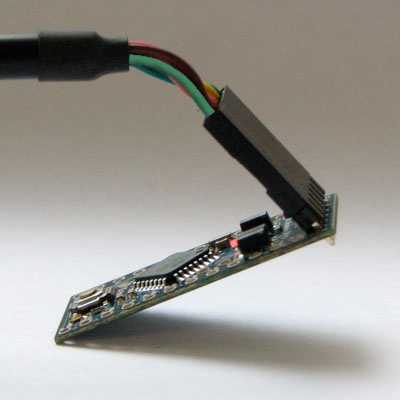
The Arduino Pro Mini connected to (and powered by) an FTDI TTL-232R-3V3 USB - TTL Level Serial Converter Cable. The green and blackness wires marshal with the labels "GRN" and "BLK" written next to the holes.
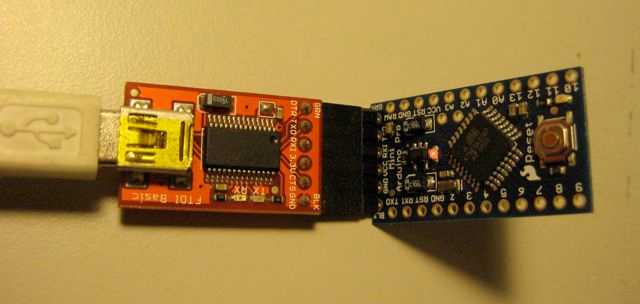
The Arduino Pro Mini connected to (and powered by) a SparkFun FTDI Basic Breakout Board and USB Mini-B cable. Note that on earlier Pro Mini boards the orientation of the half-dozen-pin header may exist reversed; check that the words GRN and BLK align on the Pro Mini and FTDI Basic Breakout.
Upload and Run your first Sketch
To upload the sketch to the Arduino Pro Mini, you lot need to printing the upload push in the Arduino environment.
Click the Upload button in the upper left to load and run the sketch on your board:
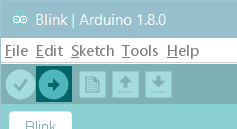
Wait a few seconds - you should see the RX and TX LEDs on the board flashing. If the upload is successful, the message "Done uploading." volition appear in the status bar.
Learn more on the Desktop IDE
See this tutorial for a generic guide on the Arduino IDE with a flake more info on the Preferences, the Lath Managing director, and the Library Manager.
Tutorials
At present that you take gear up up and programmed your Arduino Pro Mini lath, you may find inspiration in our Project Hub tutorial platform.
!!!Delight Read...
Power
The board tin be powered through USB via the vi-pin programming header or from a regulated 5V or 3.3V (depending on the model) supply applied to the VCC pin or an unregulated supply on the RAW pin.
Connectors
Any standard 0.1" spaced header can be soldered to the holes on the Arduino Pro Mini. To employ every pin requires two 12-pin headers, plus a six-pin header for programming if desired. Blank wire can also be soldered directly to the holes.
The text of the Arduino getting started guide is licensed nether a Creative Commons Attribution-ShareAlike 3.0 License. Code samples in the guide are released into the public domain.
Source: https://www.arduino.cc/en/Guide/ArduinoProMini
0 Response to "Upload Sketches to Arduino Micro With Ftdi"
Post a Comment